
Sep 2nd 2026
Choosing an Adjustable Air Resistance Exercise Bike for a Real Home Gym
An adjustable air resistance exercise bike uses a fan-driven flywheel that increases resistance in direct proportion to how hard someone pedals, so the effort put in and the resistance pushed back stay perfectly matched without a dial, button, or app doing the adjusting. Unlike magnetic bikes that rely on fixed preset levels, air resistance climbs and falls in real time, which is why interval training, full-body conditioning, and rehabilitation programs all lean on this style of machine.
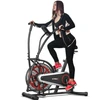
Our Upright Air Bike with Unlimited Resistance pairs that self-regulating system with a dual belt-and-chain drive, a four-way adjustable seat, and a console that tracks time, speed, distance, and calories. It is one of the more requested pieces in our sports and fitness department, and the questions we hear most often are less about the bike itself and more about how air resistance stacks up against the alternatives.
This guide walks through the mechanics, the buying criteria, and the honest tradeoffs, so the decision comes down to fit rather than guesswork.
In This Guide
- How Air Resistance Actually Works
- Air Bikes vs Magnetic and Friction Bikes: A Decision Framework
- What to Check Before You Buy One
- Full-Body Training: Why the Format Keeps Coming Back
- Setting Up an Air Bike at Home
- Common Misconceptions About Air Resistance Training
- Frequently Asked Questions
How Air Resistance Actually Works
A fan wheel sits at the front or center of the bike. Pedaling spins the fan, and the fan pushes against the surrounding air. The faster the pedal stroke, the more air the fan has to move, and the more resistance it generates. There is no ceiling to dial in, which is what "unlimited resistance" means in practice. A light spin feels easy. A hard sprint feels like pushing through a wall. Nothing needs to be set before the ride starts.
Most air bikes, including ours, add moving handlebars connected to the same drive system, so the arms work against resistance at the same time as the legs. That dual-action design is the main reason trainers reach for air bikes when the goal is full-body conditioning rather than a leg-only cardio session.
Air Bikes vs Magnetic and Friction Bikes: A Decision Framework
The three resistance types on the market solve different problems. The table below breaks down where each one earns its keep.
|
Resistance Type |
How It Feels |
Best For |
Typical Tradeoff |
|
Air (fan-driven) |
Scales automatically with effort; no ceiling |
HIIT, sprint intervals, full-body work, rehab pacing |
Louder during hard efforts |
|
Magnetic |
Quiet, precise, level-based (often 20 to 32 levels) |
Structured classes, app-based training, shared households |
Higher price for equivalent build quality |
|
Friction (belt or pad) |
Simple, budget-friendly, manually adjustable |
Casual riders on a tight budget |
Pads wear over time and need replacement |
For anyone comparing an air bike against a subscription-based magnetic model, the practical difference usually comes down to this: magnetic bikes ask the rider to choose a level, while an air bike simply responds to the effort already being put in. Neither approach is wrong. They are built for different training habits.
What to Check Before You Buy One
Not every air bike on the market is built the same way. A few specifications matter more than the marketing copy suggests.
- Drive system: belt-driven bikes run quieter than chain-driven bikes, though the joint belt-and-chain design on our upright model is built specifically to smooth out that tradeoff.
- Seat adjustability: look for both vertical and fore-aft adjustment, especially if more than one person in the household will use it.
- Frame weight and footprint: heavier steel frames resist rocking during hard sprints, which matters more than most buyers expect until they try a lightweight model at full effort.
- Console tracking: time, speed, distance, and calories are the baseline; anything less makes it difficult to measure progress over weeks.
- Portability: built-in transport wheels make a real difference once the bike needs to move for cleaning or storage.
Full-Body Training: Why the Format Keeps Coming Back
Treadmills and stationary bikes isolate the lower body. An air bike does not, because the handlebars are mechanically tied into the same resistance system as the pedals. That means a twenty-minute session touches the chest, shoulders, arms, and core in addition to the legs, which is part of why air bikes remain a staple in CrossFit-style programming and physical therapy clinics alike.
For someone returning from an injury, the self-limiting nature of air resistance is genuinely useful. A joint that cannot tolerate hard effort simply will not generate hard resistance, since the machine only pushes back as hard as it is pushed. That built-in ceiling is difficult to replicate on a fixed-resistance machine.
Setting Up an Air Bike at Home
Placement matters more than most buyers assume. Air bikes move noticeable air while in use, so a spot away from paperwork, loose fabric, or anything that catches a breeze works better than a tucked-away corner. A hard, level floor keeps the four-way seat adjustment doing its job instead of compensating for an uneven surface, and leaving a few feet of clearance around the moving handlebars avoids any accidental contact during a hard interval.
Common Misconceptions About Air Resistance Training
The most persistent myth is that air bikes are only for advanced athletes chasing brutal sprint intervals. In reality, resistance is entirely effort-based, so a slow, steady pedal produces a gentle, low-impact ride that suits beginners, older adults, and anyone easing back into activity just as well as it suits an interval-trained athlete pushing for a personal best. The bike does not know the difference between a warm-up and a sprint. It only responds to what is put into it.
Frequently Asked Questions
What is the real difference between an air resistance bike and a magnetic bike?
Air resistance scales automatically with pedaling effort and has no upper limit, while magnetic bikes use fixed levels you select manually. Air bikes suit variable-intensity training; magnetic bikes suit structured, level-based programs and quieter households.
Are air resistance bikes noisy?
Yes, more than magnetic bikes, since the fan pushes air as you pedal. Belt-driven and belt-and-chain hybrid systems, like the one on our upright model, reduce mechanical noise, though the fan itself will always be audible during harder efforts.
Is an air bike safe for rehabilitation or older adults?
Generally yes, because resistance is self-limiting. A gentle pedal stroke produces gentle resistance, so the machine naturally matches whatever effort level a person can safely sustain. A physical therapist or physician should still confirm suitability for specific conditions.
How much should a quality adjustable air resistance bike cost?
Home models typically range from roughly $300 to $1,300 depending on frame weight, drive type, and console features. Our Upright Air Bike with Unlimited Resistance sits at the accessible end of that range at $302.18 without sacrificing core build quality.
Can beginners use unlimited resistance safely?
Yes. Because resistance only builds as hard as someone pedals, a beginner riding at a light, steady pace never encounters more resistance than they generate themselves. There is no preset intensity to accidentally select.
The Bottom Line on Air Resistance
An adjustable air resistance exercise bike earns its place in a home gym by doing one thing well: matching resistance to effort without asking the rider to manage a dial. That self-regulating design is what makes it equally useful for a first-time rider easing into cardio and an experienced athlete chasing a brutal interval set. The right choice ultimately comes down to how a household trains, not which machine looks the most impressive in a showroom photo.